

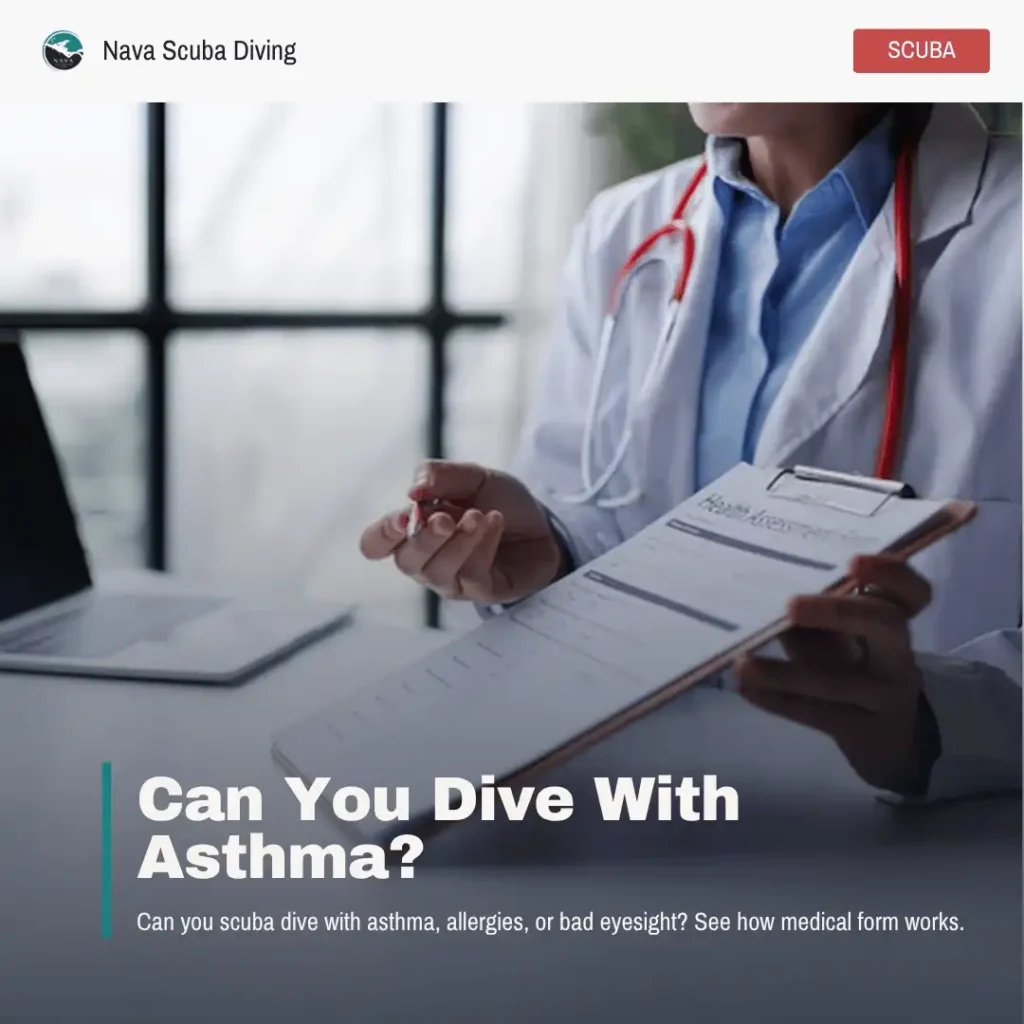
Can You Scuba Dive with Asthma, Allergies, or Bad Eyesight? What to Check Before Your First Dive
Your ferry to Koh Tao is booked, and your bag has an inhaler, allergy pills, or a pack of contact lenses in it. Can you still dive? Can you scuba dive with asthma, or with allergies, or when you can’t see much without glasses? First-time divers have similar questions. The answer is rarely a flat no. Usually it comes down to a few checks.
Pressure underwater affects your ears, sinuses, lungs, and eyes, so each condition gets its own check. Below, we cover what’s usually fine and what needs a doctor first, then the PADI medical form, which the Nava Scuba Diving team reviews at registration before your Koh Tao diving course starts.
Can You Scuba Dive with Asthma? See a Doctor First
Asthma needs more care than the other two. If an attack starts underwater, breathing gets hard, and narrowed airways can trap air in your lungs. As you ascend, the water pressure around you drops, the trapped air expands, and it can injure your lungs. DAN explains the risk in Asthma and Diving.
Having asthma doesn’t mean you cannot scuba dive, though. A doctor looks at how well your asthma is controlled and what sets it off. See one before your course if any of these apply:
- Wheezing, coughing, or chest tightness that isn’t well controlled
- Flare-ups triggered by exercise, cold air, or allergens
- Using your reliever inhaler often, or not being sure how well your asthma is controlled right now
If your answers on the medical form (see below) call for a physician’s approval, take the form to a doctor before your diving trip to get proper clearance. Tell your Nava instructor about your asthma and any medication you take, too, so the team can plan around it.
Can You Scuba Dive with Allergies? Check Your Nose and Sinuses
Generally, allergies won’t prevent you from diving. Your instructor cares less about whether you have allergies than about whether your nose is clear and uncongested enough on dive day to equalize your ears. Pressure rises as you descend and changes fastest in the first few meters, so your ears and sinuses have to keep up. When your Eustachian tubes and sinuses are open, that’s easy. When they’re blocked, problems start fast.
- Mild symptoms, like a few sneezes, are usually fine if you can breathe through your nose and equalize easily.
- A blocked, congested nose or a sinus flare-up is different. Swollen tissue can block your ears and sinuses, and forcing a descent can lead to ear pain, facial pain, or a nosebleed. Sitting that dive out is the safest choice.
The same goes for scuba diving with sinus problems. If your sinuses are inflamed or you can’t equalize, wait until they clear. If chronic sinus trouble often stops you from equalizing, see an ENT doctor before your course.
Can You Dive After Taking Allergy Medication?
Not necessarily. Medication eases the symptoms, but the risk is still there. A decongestant can wear off mid-dive, and then the air in your sinuses or middle ear can’t escape on the way up. That’s called a reverse block. Some antihistamines make you drowsy, which isn’t what you want underwater. If you need medication, check with your doctor first and only use one you’ve already taken on land. Don’t try a new one on a dive day, since you won’t know how your body will react.
This is general information, not medical advice. If you have a health condition, consult your doctor before diving.
Can You Scuba Dive with Bad Eyesight? Two Ways to See Clearly Underwater
This is definitely a yes. Being nearsighted won’t stop you from diving, as long as you can read your pressure gauge, check your dive computer, and see your buddy’s hand signals. Scuba diving with regular glasses doesn’t work, though. The frame’s arms stop the mask’s silicone skirt from sealing, and water leaks in. If your prescription is strong or you have astigmatism and don’t want everything to look blurry, you have basically two options.
1. Prescription Diving Mask
This suits you if you’d rather not wear contact lenses. Ready-made lenses cover common prescriptions, and custom lenses can match your own eyes, including astigmatism. If you’re buying one, have an optician or dive shop help you choose the lenses, and try the mask on to check that it seals. Things look bigger underwater, so we recommend a slightly weaker lens power than your everyday glasses. If you don’t have one, Nava Scuba Diving rents prescription masks. Let the team know before your course.
2. Soft Contact Lenses (Daily Disposables)
Can you scuba dive with contact lenses? Definitely, and many divers do. Use soft daily lenses only, for hygiene. Tell your instructor and practice clearing water from your mask. If your mask floods or comes off, keep your eyes closed so the lenses don’t wash out. Throw those lenses away after the dive. If your eyes get red or irritated after the dive, consult an eye doctor.
Check Your Readiness with the PADI Medical Form
Before your course starts, PADI requires every student to fill out the PADI medical form, a questionnaire that flags conditions that need a doctor’s approval. If you answer “no” to every question, you can start without seeing a doctor. Otherwise, follow the instructions on the form. If you’re a first-time diver, go through this before your course:
- Answer every question. The form covers your health history and anything that could affect your safety underwater.
- Be honest about medical conditions, symptoms, and medications.
- If you answer “yes” to anything, read the instructions on the form. Some answers lead to extra questions, and some need a doctor’s sign-off before your course.
- If you need to see a doctor, take the form with you so they can confirm whether you’re fit to dive.
- On the day, if you feel unwell, tell your instructor before you get in the water and decide together whether to dive.
Download the PADI medical form here and go through it before you travel. If you need a doctor’s sign-off, it’s easier to see one before you leave home, so you can start your course on Koh Tao as planned. At registration, the team will review the form again before your course starts.
Find the Right Scuba Diving Course on Koh Tao with Nava Scuba Diving
Passed the form, or had a doctor sign off, and not sure where to start? Nava Scuba Diving is a PADI 5-Star Dive Center and PADI Eco Center in Chalok Baan Kao, Koh Tao, with beginner courses for different schedules and comfort levels:
- Discover Scuba Diving (DSD) A one-day try dive to a maximum of 12 meters. There’s no exam and no experience needed, so it suits anyone who wants to try diving before committing to a course.
- PADI Open Water Diver Our most popular course. It takes 3 days, with 4 open water dives down to 18 meters, and you earn a certification you can use worldwide.
- PADI Eco Open Water Also 3 days, but with 5 dives and 3 certification cards. It adds PADI AWARE and Peak Performance Buoyancy, so you master hovering without touching the reef from the start.
For a closer comparison of the courses, read our beginner’s guide to getting scuba certified.
Health Questions Before Learning to Dive: FAQs
Short answers to the other health questions first-time divers ask us.
Can you scuba dive with asthma if you haven't had an attack in years?
Many people can, but you still need to answer the asthma questions on the form honestly. If the form sends you to a doctor, they may test your lung function (spirometry) before they sign it.
Can you scuba dive with a cold or a stuffy nose?
If your nose is congested and you can’t breathe freely through it, we recommend postponing the dive. Diving congested risks injuring your ears or sinuses, and that can keep you out of the water for days longer.
Do you need a doctor's certificate to learn to dive?
Not everyone does. If you answer “no” to every question on the PADI medical form, you can start right away. If an answer calls for a doctor’s approval, the doctor signs the form before you dive.
Can you dive after LASIK?
Usually, once your eyes have healed. How long you need to wait depends on the type of surgery, so ask your eye surgeon when you can go diving.
Should you tell your buddy you wear contact lenses?
Yes. If you lose a lens or your mask underwater, your buddy will know you may not see well and can help you to the surface.
How long is the PADI medical form valid?
12 months once a doctor has signed it. If you come back for another course within that time and your health hasn’t changed, you can use the same form.
Not sure whether your condition needs a doctor? Message the Nava Scuba Diving team before you book. If you can’t wear contact lenses, you can still learn, because we rent prescription masks. And if you’re still deciding where to learn, read where to learn scuba diving in Thailand, then start your first dive with us on Koh Tao.

Can you scuba dive with asthma, allergies, or bad eyesight? What’s usually fine, when to see a doctor first, and how the PADI medical form works.
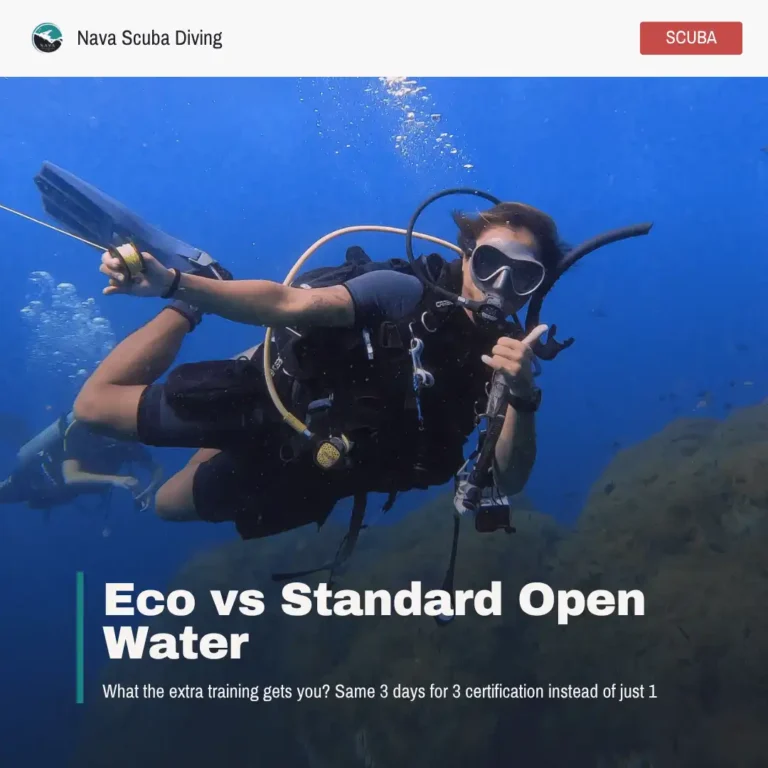
Eco Open Water vs Open Water is the same: 3 days, 1 extra dive, and 3 PADI certifications instead of 1. See what Peak Performance Buoyancy and PADI AWARE add.
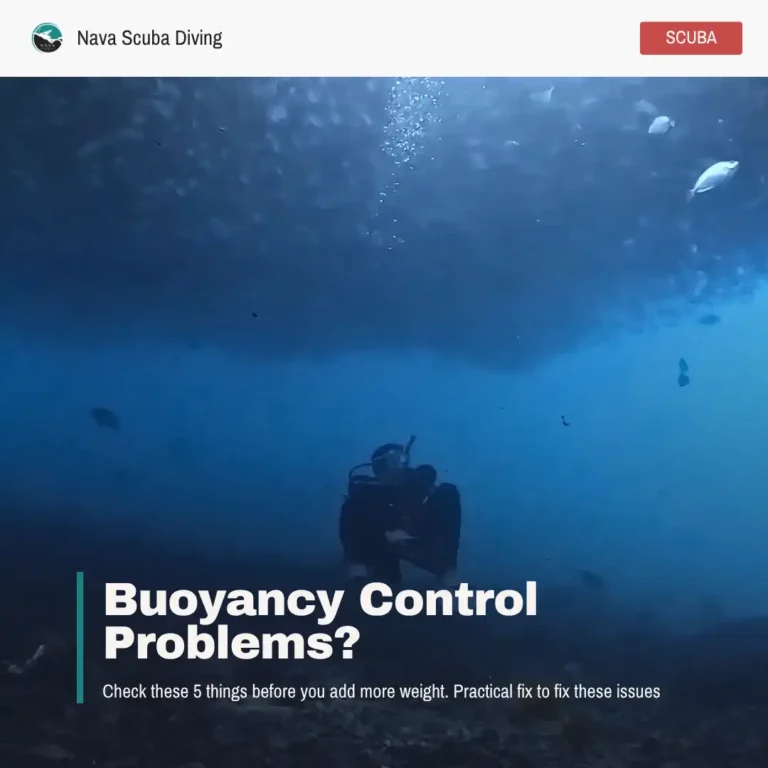
Learn why buoyancy control is important for diving, why scuba diving buoyancy can be tricky, and practical tips to improve neutral buoyancy for smoother dives.
Planning a relaxing trip? Explore Koh Tao activities and Koh Tao things to do beyond diving, from beautiful beaches and scenic views to easygoing water activities.