
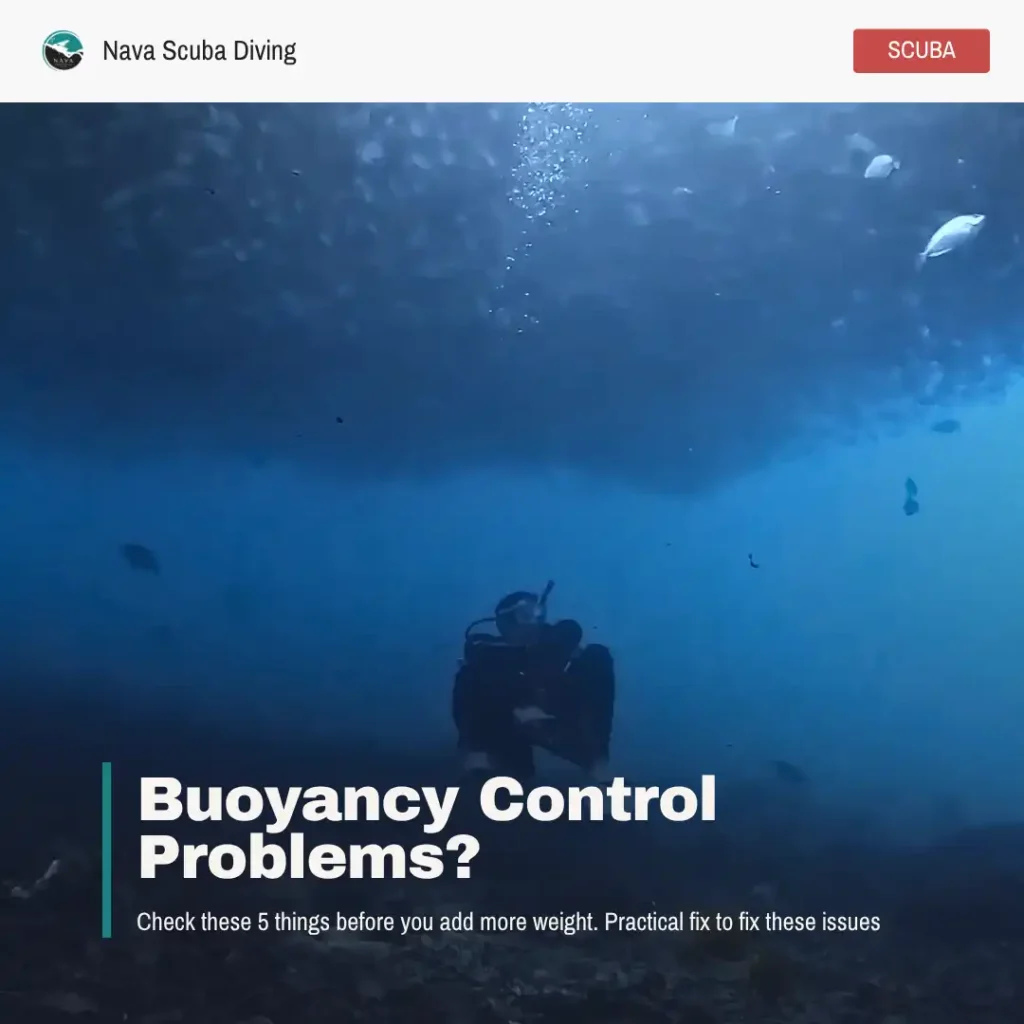
Once you master buoyancy control, diving feels completely different
Ever seen those divers with effortless buoyancy control gliding through the water so smoothly they look like they belong there, barely even kicking their fins? Then cut to yourself underwater: sinking straight to the bottom one second, floating up like a balloon the next, and getting totally exhausted trying to manage your scuba diving buoyancy.
If you are wondering what went wrong or why staying balanced underwater feels so hard, what you really need is a guide on how to improve buoyancy. Master this skill, and your whole diving experience will change. That is why Nava Scuba Diving loves helping divers build solid buoyancy control diving habits and achieve perfect neutral buoyancy from day one, starting right with the Discover Scuba Diving experience!
What is buoyancy control, and how is it different from trim?
Buoyancy control is your ability to rise, sink, or stay put exactly when you want to, on the way down, in the middle of the dive, and on the way up. It comes from your weights, your BCD, and your breathing working together. Even the BCD’s name says so: Buoyancy Control Device.
When you stop mid-water, the goal is neutral buoyancy: you neither sink nor float; you just hang there like an astronaut in a space station, breathing normally and completely relaxed. Trim is different. It’s your body position in the water: horizontal, with your legs and fins level with your body, not dangling like you’re sitting on a chair or pedalling like you’re on a bicycle.
The two go together, but you need to look at them separately. Some divers hold their depth perfectly, but their legs still hang down. Others have a beautiful flat trim but slowly sink. Once you know which one is your problem, you know what to practice next.
What changes once your buoyancy is under control?
Once you can hold neutral buoyancy without sinking to the bottom or popping up to the surface, diving feels completely different. Stopping to look at coral, peering into a crack for a fish, or lining up a photo all become calm and easy, the way you see the pros do it.

Safer diving
You hold your depth and don’t ascend faster than you mean to.

Less effort
A wide beach on the east coast with open sea views. Great for
a stroll or finding a breezy spot to sit.

Closer encounters
Marine life doesn’t bolt when you approach, and photographers can keep the camera steady and the subject in frame.

A healthier reef
This one matters most to us, because Nava is a PADI Eco Center. Fins that don’t touch the bottom mean coral that doesn’t break and sediment that doesn’t settle on the small creatures living there.
7 Signs it might be time to work on your buoyancy control
A lot of divers struggle with buoyancy without even realizing it. Run through this checklist and see if it’s time to level up your skills before your next Koh Tao dive trip.
[ ] 1. You sink as soon as you stop kicking. Usually too much lead or too little air in your BCD, so your legs end up doing the work.
[ ] 2. Your depth drifts up and down without you meaning it to. Look at how you add and dump air, how you’re breathing, and what the current is doing.
[ ] 3. You keep adding air, then dumping it, all dive long. You’re probably adding too much at once and not waiting for your body to respond before pressing the button again. Try short bursts, then wait two or three breaths.
[ ] 4. You scull with your hands. Usually a sign of tension or trim that isn’t quite right. It wastes energy and you risk hitting your buddy.
[ ] 5. Your fins or gear touch the bottom when you didn’t intend it. Check how high you’re swimming, your leg position, and any hoses or gear hanging below you.
[ ] 6. You struggle to hold your safety stop at the end of the dive. Holding the line as a reference is fine. But if you have to pull or kick yourself down for the full 3 minutes, you may be underweighted or still have air left in your BCD.
[ ] 7. You use air faster than on your own previous dives. Compare yourself with dives in similar conditions rather than with your buddy. Everyone breathes differently, and tank sizes can vary too.
Certified diver, but why does buoyancy control still feel unnatural?
Having a diving certification does not mean your buoyancy control automatically improves on every dive. The skills from your PADI Open Water Course are only half of it. The other half is the gear you’re wearing, and our instructors see the same five causes again and again.
1. Your weight has to work at the start and the end of the dive
A common mistake for newer divers is carrying too much weight out of fear of not being able to sink. Overweighting causes you to sink quickly and forces you to constantly pump air into your BCD. As depth and pressure change, that trapped air expands and compresses, making depth control a constant struggle. On the flip side, underweighting makes you too light near the end of the dive when your tank gets lighter, causing you to float up during your safety stop.
The basic check happens at the surface. Wear all your gear, empty your BCD completely, take a normal breath and hold it for a moment. If you float with the water at about eye level, and sink slowly when you breathe out, your weight is close to right. The most accurate check is at the end of a dive, when your tank is nearly empty. You can repeat the check then, or ask your instructor to allow for that difference.
2. Unbalanced weight distribution and trim
Getting the total weight right isn’t enough. Where it sits matters just as much. If you can hold your depth but your legs drop or you lean to one side, adding more lead won’t fix it, because the problem is how the weight is distributed. Lead bunched at the front of your waist tends to make your legs sink, and if one side is heavier, you’ll lean that way for the whole dive.
The right setup depends on your body shape, your gear and where your tank sits, so there’s no single formula. Change one thing at a time and see how your position changes. For example, split the weight evenly left and right, move some of it up to the trim pockets on your BCD near the tank to bring your upper body down and your legs up, or slide one weight on your belt round to the middle of your back. Whatever you do, make sure any ditchable weight can still be released easily in an emergency.
3. Your wetsuit loses buoyancy as you go deeper
Wetsuits are made of neoprene, which is full of tiny gas bubbles. As you descend, water pressure squeezes those bubbles flat, so a suit that floats you nicely at the surface gives you less and less lift the deeper you go, then expands again as you come up. The thicker the suit, the bigger that difference, which means more BCD adjustments as your depth changes.
The water around Koh Tao is warm almost all year, and many divers are comfortable in a 3 mm suit. If you feel the cold easily or do several dives a day, a thicker suit can help. Whenever you change suit thickness, redo your weight check instead of guessing from your old numbers. A suit that’s too loose causes a different problem: water flushes in and out, you get cold faster, you start breathing harder, and your buoyancy gets harder to manage.
One more thing people forget: a wetsuit that’s bone dry, hasn’t been in the water for a while, or is brand new is extra floaty, almost like wearing a rubber ring. Soak your suit the night before, or if you forget, at least give it 30 minutes in the water before your dive. It makes a real difference.
4. A snug BCD and a secure tank
A loose BCD shifts around every time you turn or tilt. The tank on your back moves with it, sometimes sliding to one side until you’re tilted, and you end up tensing to pull yourself straight. Before the dive, tighten the straps so the BCD is snug, but you can still breathe and move comfortably. Most BCDs adjust across a wider range than people expect. If it’s still loose with every strap fully tightened, it’s too big for you, so ask for another size.
A BCD that fits well doesn’t mean the tank is secure. Check the tank strap separately, or have your buddy look at it during your Buddy Check before you get in.
5. Changing tanks means checking your weight again
Steel and aluminium tanks behave differently in the water, and even two tanks of the same material can differ between models. Take the aluminium Catalina S80 as an example. The manufacturer lists it as slightly negative when full, around −0.7 kg (−1.6 lb), and positively buoyant when empty, around +1.9 kg (+4.1 lb). That swing of almost 2.6 kg is exactly why a diver who’s perfectly weighted at the start of the dive can end up floating off their safety stop.
If you switch between steel and aluminium, don’t use the same weight. Tell your instructor what type of tank you’re used to and do a fresh weight check before you dive. If you’re worried about forgetting, log it in the Digital Logbook on the PADI App.
How to improve Scuba Diving Buoyancy: work out what to fix
Start by describing the problem to your instructor in detail. For example: “I’m fine at the start of the dive, but once I get shallow, I have to kick down,” or “My depth is steady, but my legs hang until my fins touch the bottom.” Those two point to completely different causes, and they’re far more useful than just saying “my buoyancy control is bad.” Your instructor can then watch you in the water and adjust one thing at a time, so you can see what helps and what still needs practice.
Your breathing can fine-tune your position a little. Breathe in deeply, and you rise slightly; breathe out slowly, and you sink slightly. That’s ideal for small adjustments while you’re hovering, but bigger depth changes still need your BCD. Whatever you’re adjusting, never hold your breath underwater.
After each dive, note these down in your logbook so your next conversation with your instructor is quicker:
- Which tank you used, how thick your suit was, and whether it was fresh or salt water
- How much weight you wore in total, and where you put it
- What problem you noticed, when it happened, and roughly how much air you had left at the time
- What you changed and what buoyancy control difference it made
Level up your buoyancy control with Nava Scuba Diving
By now, you’ve probably noticed that buoyancy control isn’t just about adding air to your BCD. It’s a mix of weight, trim, breathing, and movement all working together. The good news is you can build these skills gradually as you keep diving. PADI actually has a whole course dedicated to this called Peak Performance Buoyancy (PPB), and here at Nava Scuba Diving, we build these same skills into our courses too.
Sharpen your buoyancy with PADI Advanced Open Water
Take your PADI Open Water certification further with the PADI Advanced Open Water Diver course on Koh Tao, a 2-day, 5-dive program. Choose Peak Performance Buoyancy (PPB) as one of your 3 Adventure Dives, alongside required dives like Deep Diving (30 meters) and Underwater Navigation. This dive hones your trim, weighting, and breath control for precise depth management. The payoff: longer air time, smoother movement, and real confidence at deeper sites.
Master your buoyancy and protect the ocean in the Eco Open Water Course
For beginners looking to get certified, our 3-day, 5-dive PADI Eco Open Water course is the ultimate starting point. This upgraded experience combines the classic Open Water curriculum with Peak Performance Buoyancy (PPB) and PADI AWARE. You will learn body positioning, breath control, and precise weight distribution right from your very first dive, skipping the trial and error. Best of all, you will earn 3 PADI certifications (Open Water, PPB, and AWARE), making you a skilled, eco-conscious diver right from day one!
Buoyancy control made simple: What every diver should know
Before you pack your bags and head to Koh Tao to nail your buoyancy control, let’s run through the questions divers ask most, short and to the point, so you’re fully ready before you hit the water.
What is buoyancy control?
Buoyancy Control is your ability to manage your position underwater, floating, sinking, or staying perfectly still, exactly when you want. It comes down to your weight, BCD, breathing rhythm, and trim all working together.
What is neutral buoyancy?
Neutral Buoyancy is that sweet spot where you’re neither sinking nor floating up, just hovering in place without kicking your legs or messing with your BCD button. It’s basically the end goal of good buoyancy control.
Why am I struggling to stay stable underwater?
Most often, it comes down to improper weighting, rapid breathing from nerves, unrefined trim, or paddling with your hands instead of using breath control.
I'm already certified but still struggle with buoyancy. What should I do?
Start doing a pre-dive buoyancy check every time to find your ideal weighting. Pay attention to your trim and gear setup, or sign up for a follow-up course like PADI Advanced Open Water Diver or Peak Performance Buoyancy (PPB), where an instructor can watch you dive and give you personalized feedback.
Does good buoyancy really save air?
Yes, it does. The less you kick and the less effort you use, the slower and calmer your breathing gets, which means you can stay underwater longer on the same tank.
How does buoyancy control help protect coral reefs?
When your buoyancy is steady, you’re way less likely to bump coral with your fins or hands, kick up sediment, or disturb marine life around you.
Understanding buoyancy control not only explains why staying balanced underwater can feel tricky, but it also unlocks effortless stability, better air consumption, and eco-friendly diving. If you want to learn how to improve buoyancy and achieve true neutral buoyancy, our team at Nava Scuba Diving is here to refine your posture and technique from day one. Elevate your buoyancy control diving skills with us, perfect your scuba diving buoyancy, and get ready to explore the stunning waters of Koh Tao together!

Learn why buoyancy control is important for diving, why scuba diving buoyancy can be tricky, and practical tips to improve neutral buoyancy for smoother dives.

Planning a relaxing trip? Explore Koh Tao activities and Koh Tao things to do beyond diving, from beautiful beaches and scenic views to easygoing water activities.
Feeling sore or tired after a dive? Learn what causes DCS symptoms after diving and the right way to prevent them, so you can dive worry-free.
Worried about seasickness before diving? Nava Scuba Diving shares proven ways to handle it, from rest and food to picking the right seat and using medication safely.